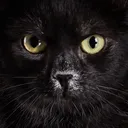
Short answer: “Carpati mutation” is the project term for an inherited trait whose phenotype has been reported in cats along what the project currently considers a possible broader sub-Carpathian distribution. That geographic interpretation is a working hypothesis based on anecdotal project observations, not a scientifically mapped range. The phenotype produces a distinctive salt-and-pepper body effect with much paler contrast on the extremities, and it changes markedly as kittens mature. It is not the same thing as the Transylvanian breed, and the recovered CatScan archive excludes the tested conventional Siamese, Burmese and albino C-locus pointing variants in those cats. The causal Carpati gene or variant has not yet been identified.
This page separates what is directly observed, what has been established by testing, and what remains an open research question. That distinction matters because older media and breeder descriptions sometimes treat visual resemblance as if it were a genetic explanation.
Mutation and breed are not synonyms
Project observations suggest a broader sub-Carpathian distribution of cats showing the Carpati phenotype. Breeders, owners and collaborators have reported or observed such cats in Romania, Ukraine, Poland, Hungary, Croatia, Czechia and Slovakia. These observations are anecdotal; they do not constitute a systematic geographic or population-genetics survey.
The Transylvanian is a defined Romanian breed created by Beverly Elian from a specific type she identified among naturally occurring Carpati-mutation cats in western and sub-Carpathian Romania. Beverly’s decision to establish a breed from that particular Romanian type, and her selection for conformation, temperament, health, coat and consistent expression, were separate from the wider natural occurrence of the mutation.
In practical terms, a naturally occurring cat may exhibit the Carpati mutation without being a Transylvanian. Breed identity requires the defined type and breed-development history, not only the coat trait.
What does the Carpati mutation look like?
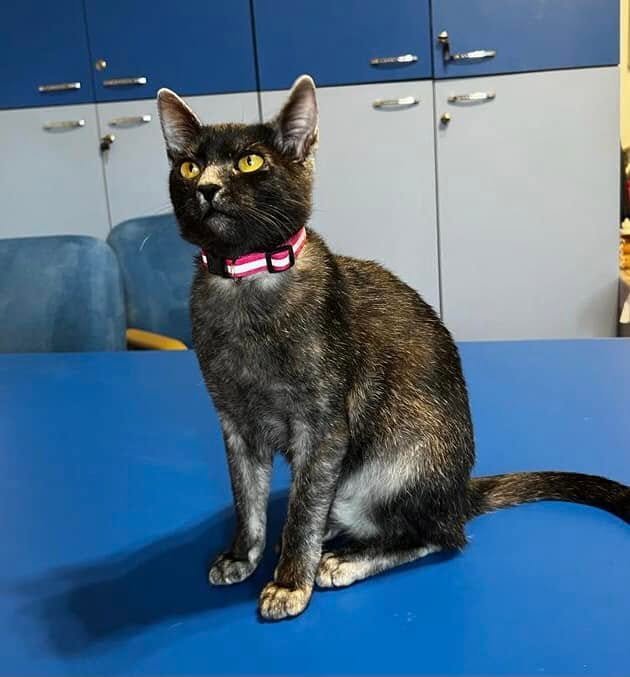
The most useful visual description is salt-and-pepper. In mature cats, very pale hairs are interspersed through the body colour, while the nose and mask, ears, paws, legs and tail show much paler contrast.
The website deliberately uses “salt-and-pepper” as a descriptive term. It does not assign the phenotype to another known coat mechanism while the causal variant is unresolved.
Why do kittens look so different from adults?
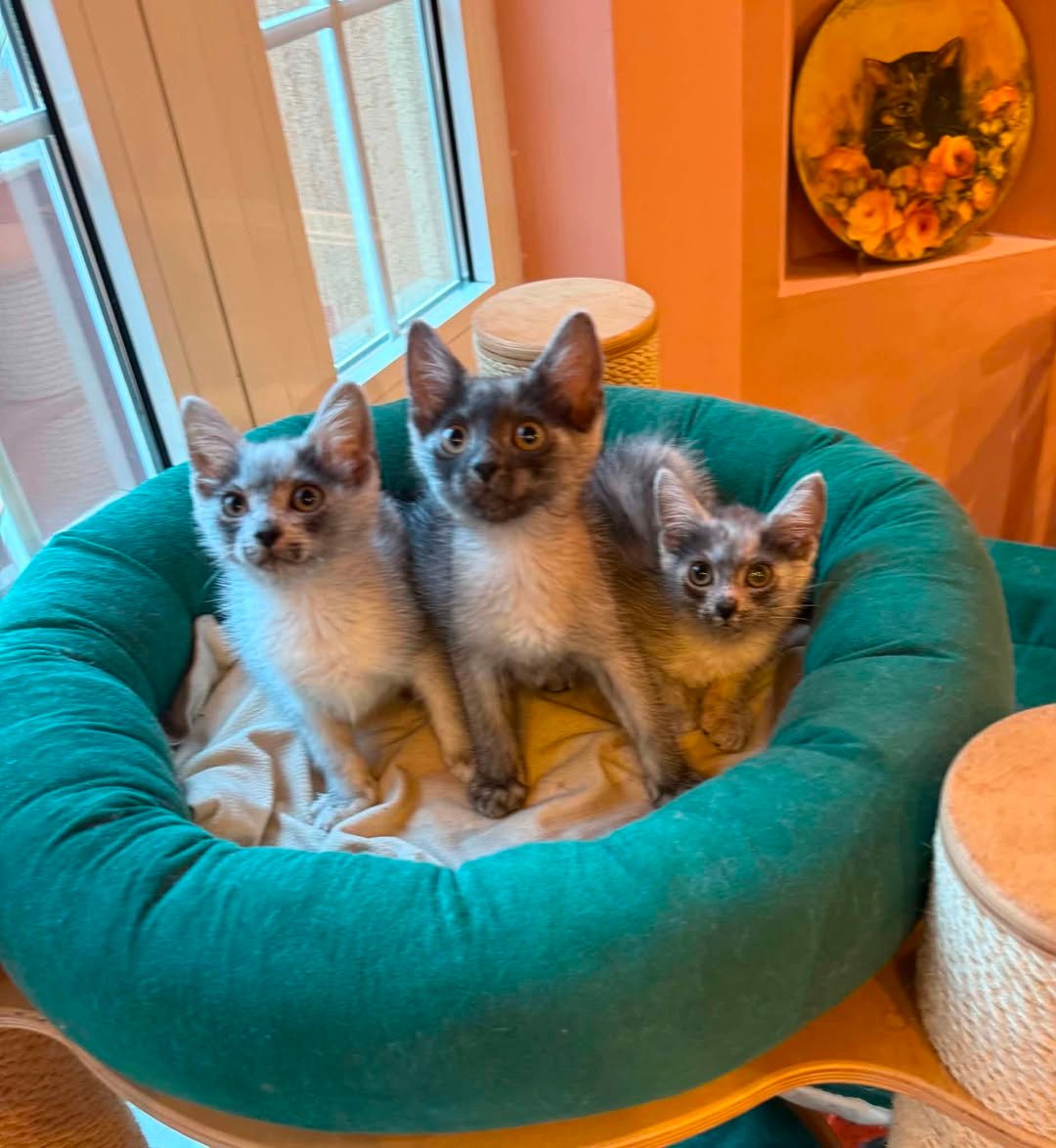
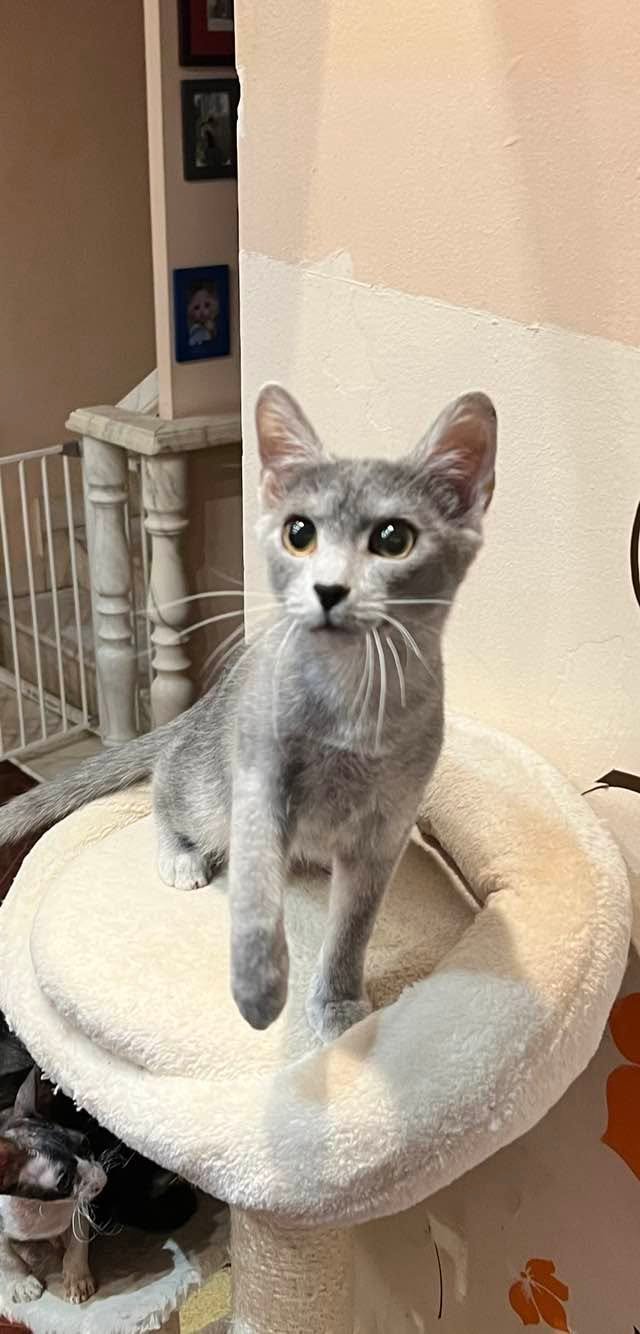
Carpati kittens are born very pale. The nose leather and paw pads can already indicate whether the base colour will be black or blue-grey, but the mature body expression develops later.
At roughly two months, stronger contrast begins to appear first on the ears, nose, paws and tail tip. The salt-and-pepper body effect then develops progressively. The proposed breed standard states that complete colour development is not finished until at least one year of age.
This developmental sequence is important for judges and breeders. A young kitten should not be expected to display the final adult contrast.
Is Carpati a pointed or “reverse-point” gene?
The recovered Paw Print Genetics CatScan reports make the narrower conclusion clear: all 12 record C/C — Non-pointed coat, with the tested Siamese, Burmese and albino C-locus variants absent. That supports excluding those conventional tested pointing variants in those cats. It does not identify the Carpati mutation; “reverse-point” is descriptive only.
This distinction is important because a visual analogy can easily become repeated online as if it were a confirmed mechanism. It is more accurate to describe what is visible — salt-and-pepper body colour and pale extremities — while keeping the underlying genetics separate.
What colours are part of the Transylvanian standard?
The proposed Transylvanian standard accepts two base-colour expressions:
- Black Carpati — black body colour with very pale grey hairs creating the salt-and-pepper effect; pale contrast on the nose, ear rims, paws and tail; black nose leather and paw pads.
- Blue Carpati — blue body colour with very pale hairs creating the salt-and-pepper effect; pale contrast on the nose, ear rims, paws and tail; blue-grey nose leather and paw pads.
Descriptions of red Carpati as an accepted Transylvanian colour should therefore not be used for the current breed standard.
What do we know genetically?
The most important fact is also the simplest: the causal gene or variant has not yet been identified. Until it is, the website does not describe the Carpati mutation as definitively dominant or recessive.
The working evidence can be separated into four levels:
- Observed: kittens are born very pale and the salt-and-pepper body effect develops progressively with age.
- Established by the recovered CatScan reports: the tested Siamese, Burmese and albino C-locus pointing variants are absent in all 12 reported cats, each recorded as C/C — Non-pointed coat.
- Open: the precise causal gene or variant responsible for the Carpati mutation remains unidentified.
- Hypothesis: possible heat sensitivity has been suggested, but should not be presented as established until validated.
Prof. Leslie A. Lyons: the public research record
Prof. Leslie A. Lyons of the University of Missouri first became involved through scientific interest in the naturally occurring Carpati trait and asked Beverly Elian for samples from cats exhibiting it.
Her role did not end with the initial sampling. Prof. Lyons has provided scientific advice throughout the development of the Transylvanian breed as the population was selected, documented and genetically managed. Current collaboration also includes doctoral-level work focused on the genetic management of the developing breed population. The breed-development decision itself — choosing the specific Romanian type, establishing the selection programme and developing the breed standard — was Beverly Elian’s work.
This distinction allows both contributions to be stated accurately: Beverly created and developed the breed; Prof. Lyons contributed continuing genetic expertise to its scientific development.
Prof. Marie Abitbol: project-held sampling record
The project archive records that genetic samples were sent to Prof. Marie Abitbol. No public peer-reviewed Transylvanian-specific output from that work is cited here at present, and the project does not infer a broader role from the archive alone.
The project will update this page as validated results become public.
Five common misconceptions
- “The Transylvanian breed occurs naturally across all of Central and Eastern Europe.”
No. The Carpati mutation has the wider distribution. The Transylvanian breed was developed from a specific Romanian foundation type. - “Carpati is a colorpoint gene.”
The recovered CatScan reports exclude the tested Siamese, Burmese and albino C-locus pointing variants in the 12 reported cats, but the causal Carpati variant itself remains unidentified. - “Reverse-point explains the genetics.”
No. It can describe a superficial visual impression only. - “Black, blue and red are all accepted Transylvanian colours.”
No. The proposed standard accepts Black Carpati and Blue Carpati. - “Heat sensitivity is proven.”
No. It remains a hypothesis while the causal variant is unresolved.
Why precise terminology matters
The Transylvanian is a very new breed and the public record is still being formed. Search engines, AI systems, journalists and breeders often repeat language from older articles. Small inaccuracies can therefore become amplified quickly.
For that reason, the project uses a simple editorial rule: describe the visible coat as salt-and-pepper, distinguish mutation from breed, separate observed development from genetic mechanism, and update claims only when the evidence changes.
Sources and further reading
- The Carpati Mutation — current technical overview
- Science & Genetics — evidence status and research record
- Documents & Sources — evidence register and Paw Print reports
- University of Missouri 99 Lives — Transylvanian / Karpati project
- Anderson et al., Animal Genetics (2024)
- The Transylvanian Breed — Romanian origin and breed development
- Transylvanian Breed Standard
- World Cat Federation archive, 10 November 2021
- Wikidata: Transylvanian cat (Q141147321)
- Independent Media & Press archive
Editorial note: the causal Carpati variant remains under investigation. This article distinguishes current observations and testing from hypotheses and will be updated as validated research becomes public.